Precision Diagnostics · Istanbul
MRI Fusion Prostate Biopsy:
see the target before the needle moves.
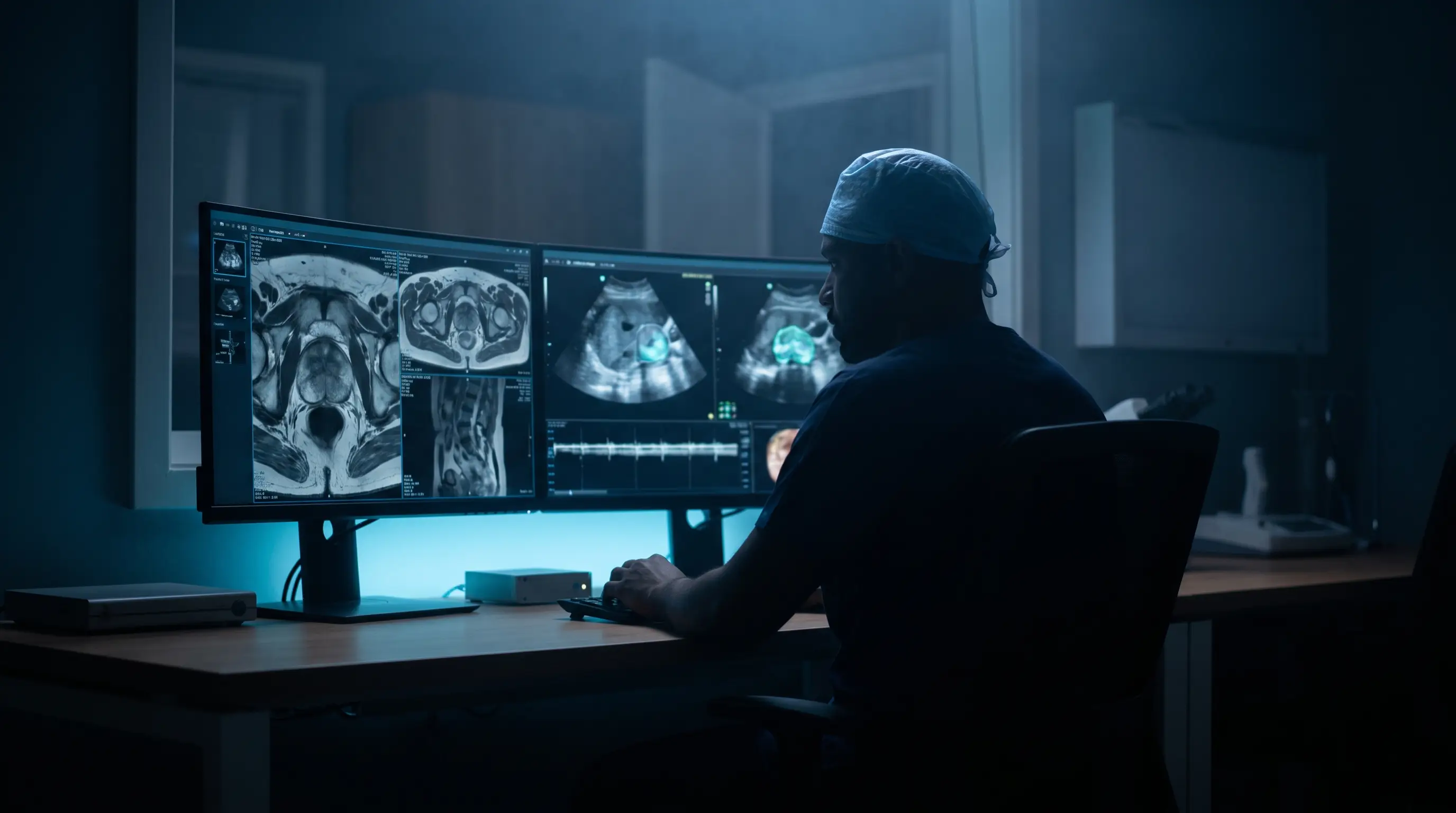
A rising PSA deserves an answer, not a guess. Software-fusion of multiparametric MRI with live 3D ultrasound lets our urologists sample the exact suspicious millimetres — detecting the cancers that matter, and sparing you the ones that never would.
The Problem
The blind biopsy: twelve needles, one hope.
The conventional biopsy samples the prostate in a fixed twelve-point template — without ever seeing the tumour. The consequences run both ways: up to 30% of clinically significant cancers are missed (a falsely reassuring result while the disease grows), while tiny harmless cancers are found by accident, dragging men into treatment they never needed. Repeat “just to be sure” biopsies multiply the discomfort, the infection risk, and the anxiety.
The Resolution
Image first. Then aim.
We reverse the order. First, a multiparametric MRI read by a dedicated uro-radiologist against PI-RADS criteria maps every suspicious zone. The fusion platform then overlays that map onto live 3D ultrasound, and the needle samples the target itself — transperineally, through skin cleansed to near-zero infection risk, under local anesthesia or light sedation. No suspicious lesion on MRI? In selected cases, no biopsy at all — the best needle is the one you never need.
Why the transperineal route matters.
Most clinics worldwide still biopsy through the rectum — a route that carries a small but real risk of serious infection, and which physically cannot reach the anterior prostate where a meaningful share of tumours hide. Our standard is the transperineal approach: through the skin, under antiseptic control, with access to every zone of the gland. Published sepsis rates approach zero.
Every core is labelled to its exact coordinates, so if treatment is ever needed, your surgeon knows precisely where the disease lives — the map that makes nerve-sparing robotic surgery plannable, and focal or surveillance strategies honest.
And because a biopsy is only as good as its pathology, every case is graded by sub-specialist uro-pathologists and reviewed at our multidisciplinary tumour board before any recommendation reaches you.
This programme is for you if
- Your PSA is elevated or rising and you want certainty, not a template guess.
- A previous standard biopsy was negative, but the PSA keeps climbing.
- You are on active surveillance and due for a re-confirmation biopsy.
- You have an MRI report (PI-RADS 3–5) and need expert targeted sampling.
Your diagnostic stay, step by step.
-
Before travel — remote triage
Your PSA history and any prior imaging are reviewed remotely. If you already hold a recent quality MRI, we re-read it — sometimes that alone changes the plan.
-
Day one — multiparametric MRI
A 3-Tesla prostate MRI on arrival day, read the same evening by a dedicated uro-radiologist and scored against PI-RADS v2.1.
-
Day two — the fusion biopsy
Twenty to thirty minutes under local anesthesia or light sedation: targeted cores into each MRI lesion plus systematic mapping cores, all transperineal. You walk out the same afternoon.
-
Day three to four — answers, in person
Expedited pathology returns within 48 hours. Your urologist sits with you and your translator, explains every core, and — if anything needs treating — presents the tumour-board-reviewed options before you fly.
-
For life — a baseline that travels with you
Your complete imaging and pathology archive is yours, in English, through your encrypted channel — the reference point for every future PSA reading.
Fusion biopsy, asked and answered.
Is a fusion biopsy painful?
My previous biopsy was negative but my PSA keeps rising. Does this help?
What if the MRI shows nothing suspicious?
Certainty in four days, not four months.
Send your PSA history privately. A uro-oncology specialist will map your fastest route to a definitive answer within one business day.