Functional Urology · Istanbul
Male Urinary Incontinence:
the pads are optional. Control is not.
Leakage after prostate surgery — or with effort, coughing, or golf swings — is one of medicine’s quietest burdens and one of its most fixable. From the adjustable male sling to the AMS 800 artificial sphincter, continence can be surgically restored at any age.
The Problem
Cured of cancer — captive to a pad.
After prostatectomy, a minority of men are left with a sphincter that no longer seals: leakage with standing, lifting, laughing. The advice they receive — “give it time, do your exercises” — is correct for the first year and quietly cruel after it, because leakage persisting beyond 12 months rarely resolves on its own. Men shrink their lives around it: dark trousers, mapped bathrooms, abandoned sport, declined invitations. Years pass in pads for a condition surgery fixes in an hour.
The Resolution
Two devices. One outcome: dry.
For mild-to-moderate leakage (one to three pads a day), the male sling repositions and supports the urethra through one hidden incision — passive, nothing to operate, dry rates of 70–80% in well-selected patients. For moderate-to-severe leakage, the AMS 800 artificial urinary sphincter — the four-decade gold standard — places a gentle fluid cuff around the urethra, opened at will by a concealed scrotal pump. Around 90% of patients achieve social continence: zero or one security pad, and a life that stops being scheduled around bathrooms.
Matching the device to the leak — objectively.
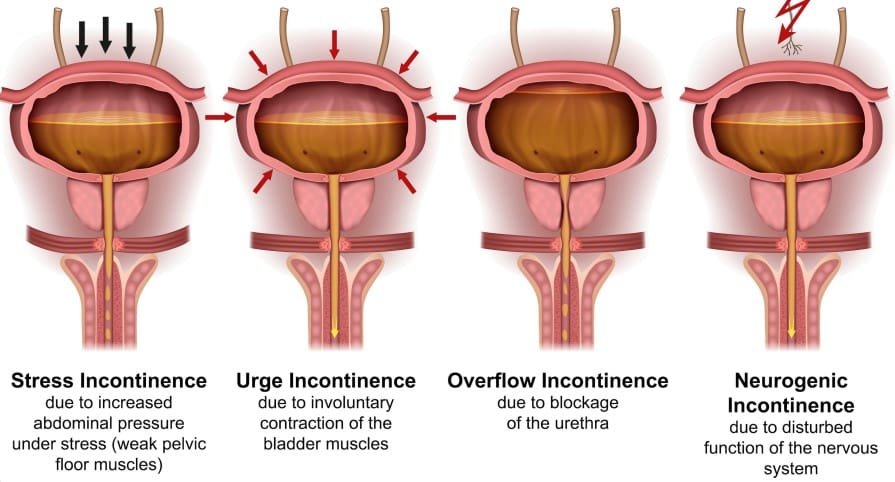
The choice between sling and sphincter is not taste — it is measurement. A 24-hour pad-weight test quantifies the leak; urodynamics confirm the bladder itself is healthy; cystoscopy checks the sphincter zone and rules out scarring. Only then is a device recommended — and if your leakage stems from an overactive bladder rather than a weak sphincter, we will tell you so and treat that instead, because an implant cannot fix a diagnosis it was never designed for.
Both procedures take under an hour through a single perineal incision. The sling works immediately. The sphincter is activated at six weeks — a deliberate healing pause — after which a discreet squeeze of the pump opens the cuff to void, and it re-closes itself automatically. Modern devices function reliably for 10–15 years, and radiotherapy patients and re-do cases are routinely accepted: complexity is precisely what patients travel to us for.
Incontinence after prostate cancer treatment often travels with erectile changes; where both need answers, sphincter and penile prosthesis can be placed in one combined, discreet operation.
This programme is for you if
- You still need pads 12+ months after prostate surgery.
- Coughing, lifting, or sport reliably causes leakage.
- Pelvic floor therapy plateaued and you want the definitive step.
- A previous sling or sphincter elsewhere failed — revisions welcome.
The road back to dry.
-
Remote review — quantify the leak
Your surgical history, pad usage, and any prior tests are reviewed remotely; a simple home pad-weight protocol before travel makes day one efficient.
-
Day one — objective confirmation
Urodynamics and cystoscopy in one visit confirm sphincter-type leakage and finalise the device choice — sling or AMS 800 — with you, not for you.
-
Day two — the procedure
Under an hour, one hidden incision, one observed night. Most men walk comfortably the same evening.
-
Days three to five — recovery & flight clearance
Suite-based recovery with daily checks, then fitness-to-fly. Sling patients often notice the difference before they board.
-
Week six — activation (sphincter patients)
Guided remotely through your encrypted channel, your surgeon activates the device with you and confirms technique. From that day, you decide when to void — not the leak.
The questions men wait years to ask.
How long should I wait after prostate surgery?
Sling or artificial sphincter — who decides?
Is the device noticeable — to anyone?
You survived the cancer. Now retire the pads.
Describe your situation privately — including how many pads, and since when. A functional urology specialist replies within one business day.